
Why the shop-floor dispatch TV is usually wrong — and what it takes to make it right
A screen everyone trusts and no one maintains
Most discrete manufacturers have solved, in some form, the problem of getting a job list in front of the shop floor. Usually it's a TV mounted at the work center. Usually it's a spreadsheet.
Someone builds it. Someone is supposed to update it every time priorities shift. In practice, that someone is busy running the floor, and the board updates when they get a spare minute — which, on a busy day, is never.
The result is a screen the whole team looks at, and no one fully trusts. Operators ask a supervisor to confirm what the board says. The supervisor, who was in the middle of something else, stops to answer. The board was supposed to remove that interruption. Instead it just moved it.
What it actually costs
The cost of a stale dispatch board doesn't show up as a single line item — it shows up as friction, scattered across the shift.
It shows up in coordination overhead. Every time the board and reality disagree, someone has to resolve it, and that someone is almost always a supervisor who has better things to do.
It shows up in job priority drift. When the board lags SyteLine, the floor is working off yesterday's plan.
It shows up in the maintenance burden nobody signed up for. Someone owns that spreadsheet, whether or not it's in their job description, and that ownership doesn't scale.
Why the obvious fixes don't hold up
The instinct is to fix the spreadsheet — tighten the process, assign clearer ownership, add a reminder. That buys a little time and then decays the same way, because the underlying problem was never the spreadsheet. It was that the board and the system of record were never actually connected.
What changes when the board can't fall behind
The fix isn't a better spreadsheet or a smaller version of an existing screen. It's a board with no manual step in its path at all — where the data comes straight from SyteLine, on a fixed refresh cycle, with nothing for a human to keep current.
Once the board can't fall out of sync, the questions it used to generate disappear along with it. There's nothing to double-check because there is nothing being entered by hand.
What we built
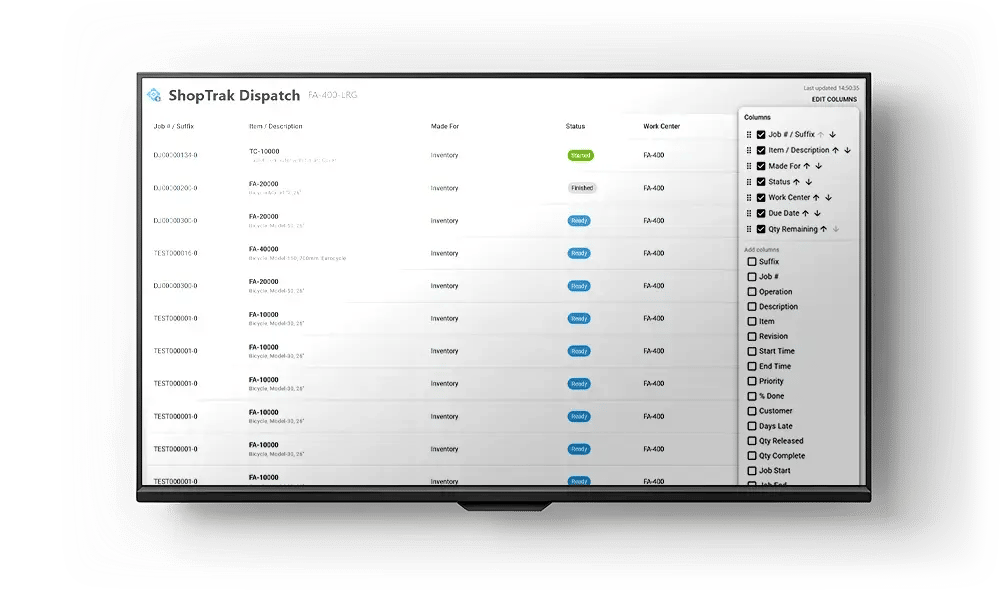
We rebuilt Visual Dispatch from the ground up as a live, read-only board designed specifically for a TV or large display at the work center — running inside Shop-Trak Mobile and pulling directly from SyteLine through Shop-Trak's existing infrastructure. No new integration project, no separate system to stand up.
What it does today:
- A prioritized job list, pulled live from SyteLine — no manual entry, ever
- Auto-refresh, so a priority change in SyteLine shows up on the board regularly
- An in-app column editor — choose the fields and order that matter to your floor, and it saves a layout you can reuse or copy to another display
- Resource-group scoping, so each screen shows exactly the work center it's posted at
- Large, glanceable formatting built for a TV
- Simple device setup — register the display once, and it boots straight into the board with no login required
Where it stands today
Visual Dispatch is rolling out now as part of the Shop-Trak Mobile release train. We've walked customers through it directly, refining the layout and field choices based on what actually matters on their floor, and we're continuing that process with a small group of early users before it's broadly available.
See it in action
If your shop floor has a TV running a spreadsheet instead of your ERP, we'd like to show you what replaces it.
The board that used to fall behind doesn't have to anymore.